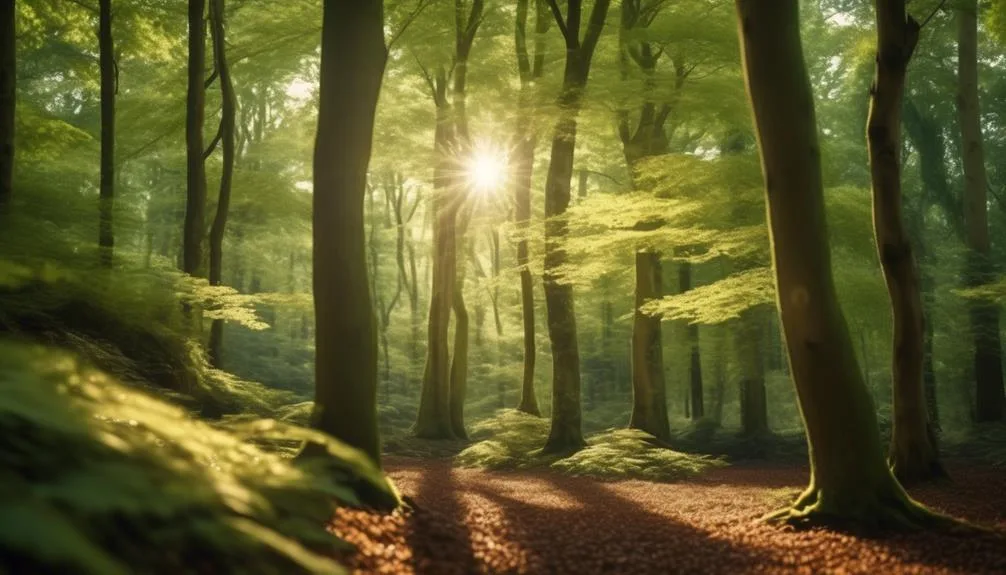
Looking to enhance your landscape? Consider planting beech trees, which can live for over 300 years.
But where to plant them for best growth? Factors like sunlight, soil, water, space, and climate play vital roles. These aspects significantly impact the health and growth of beech trees, determining their long-term success.
So, where to begin? Let's explore the key factors for ensuring your beech trees thrive in their new home.
Sunlight Requirements
To ensure optimal growth for your beech trees, it's essential to provide them with the right amount of sunlight throughout the day. Beech trees exhibit varying degrees of shade tolerance depending on their age and environmental conditions. Young beech trees typically thrive in partial shade but will require more sunlight as they mature. Understanding their growth patterns is crucial for proper placement in your garden or landscape.
Regular pruning techniques and tree maintenance also play a vital role in optimizing sunlight exposure for your beech trees. By carefully managing the surrounding vegetation and employing strategic pruning, you can ensure that your beech trees receive the ideal amount of sunlight for healthy growth and development.
It's important to monitor and adjust as needed to support the best possible growth for your beech trees.
Soil Conditions
For optimal growth of your beech trees, ensure that the soil conditions are well-drained and rich in organic matter to support healthy root development.
When choosing the right location for planting your beech trees, pay attention to the following soil conditions:
- pH Levels and Drainage
- Opt for slightly acidic to neutral soil with a pH range of 6.0 to 7.5 for optimal beech tree growth.
- Ensure the soil has good drainage to prevent waterlogging, which can lead to root rot and other issues.
- Nutrient Content and Compaction
- Check that the soil is rich in nutrients, particularly in organic matter, to support the beech tree's growth and development.
- Avoid compacted soil as it can hinder root expansion and nutrient uptake.
Healthy soil conditions are essential for the successful growth of beech trees, ensuring they thrive and contribute to the beauty of your landscape.
Recommended Products

Quick, at home results for Soil pH, Nitrogen, Phosphorous and Potash Innovative and inexpensive soil test kit features an easy-to-use capsule system and patented color comparators

Kindly NOTE: This soil tester can not be applied to test pH value of any other liquid. If the soil is too dry the indicator will not move, and water it before testing.

KNOW BEFORE YOU GROW | Grow the healthiest, sustainable lawn and garden with the most accurate and easy to use professional soil test kit on the market
Watering Needs
When ensuring optimal growth for your beech trees, it's crucial to provide consistent and adequate watering to support their root development and overall health. Beech trees have shallow root systems that spread wide, so it's essential to water them deeply and regularly to encourage deep root growth.
The root depth of beech trees is typically within the top 12-18 inches of soil, so focusing on consistent moisture in this area is key. Mulching around the base of the tree can greatly benefit water retention, as it helps to conserve soil moisture and regulate soil temperature. Additionally, mulch acts as a protective barrier, preventing soil compaction and reducing water runoff.
Space and Location
Selecting the right space and location for planting your beech trees is crucial for their successful growth and development. When considering the space and location for your beech trees, keep the following in mind:
- Tree Spacing and Root Competition
- Beech trees require ample space for their roots to spread and thrive. Ensure proper spacing between trees to minimize root competition, typically at least 20-30 feet apart.
- Planting other deep-rooted vegetation near beech trees can lead to root competition, so plan your landscape accordingly.
- Urban Planting and Pollution Effects
- In urban areas, beech trees can struggle due to pollution. Consider planting in less polluted areas to promote healthier growth.
- Pollution can lead to leaf damage and hinder the tree's ability to photosynthesize, impacting its overall health. Be mindful of pollution effects when choosing a location for your beech trees.
Recommended Products

Ready to Plant: Healthy seedlings that are ready to plant.
Ready to Plant: Healthy seedlings that are ready to plant.
Climate Considerations
After considering the impact of urban pollution on beech tree growth and the importance of proper spacing, you'll want to turn your attention to the climate considerations that can significantly influence the success of your planting efforts.
Beech trees thrive in temperate climates with a fairly wide temperature range. They prefer average annual temperatures between 45°F and 70°F, making them well-suited to regions with distinct seasons.
Additionally, adequate precipitation levels are crucial for beech tree growth. They require an average of 30 to 60 inches of rainfall per year, although they can tolerate dry periods once established. Furthermore, consistent moisture is essential during the growing season.
Selecting a planting site with these climate conditions in mind will provide the optimal environment for your beech trees to flourish.
Conclusion
To ensure optimal growth of beech trees, consider the following factors:
- Sunlight: Beech trees require a good amount of sunlight to thrive. Choose a location that receives at least 6 to 8 hours of direct sunlight per day.
- Soil: Beech trees prefer well-draining soil with a pH level between 6.0 and 7.5. Conduct a soil test to determine the soil composition and make necessary amendments to ensure optimal growth.
- Watering: Provide regular and consistent watering to your beech trees, especially during dry periods. Avoid overwatering as it can lead to root rot.
- Space: Beech trees are known for their broad spreading canopies. Ensure that you provide enough space for the tree to grow and spread its branches without obstruction.
- Climate: Consider the regional climate before planting beech trees. They are best suited for temperate climates with moderate rainfall and moderate temperatures.
By carefully choosing the right location, providing proper care, and considering regional climate, you can set the stage for the thriving and flourishing of your beech trees in their new environment.

My interest in trees started when I first saw the giant sequoias in Yosemite.I was a teenager then, and I remember thinking, “I need to learn more about this.”That moment stuck with me.A few years later, I went on to study forestry at Michigan Tech.
Since graduating, I’ve worked in a mix of hands-on tree care and community education.I’ve spent over ten years helping people understand how to plant, maintain, and protect the trees in their neighborhoods.I don’t see trees as just part of the landscape.They are living things that make a real difference in our daily lives.