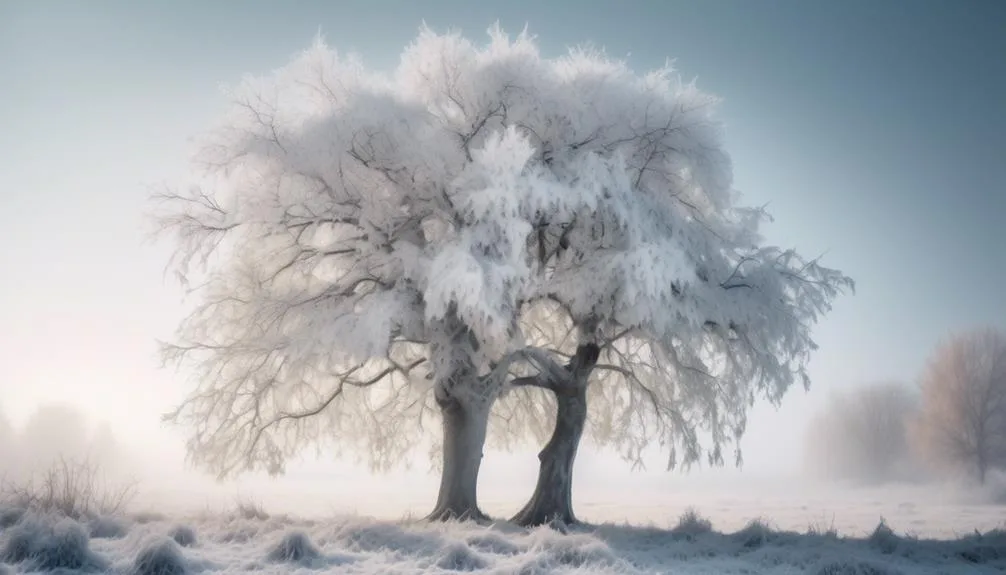
Are sycamore trees really tough enough to handle frost?
As their leaves change and fall, you might be curious about how these trees handle freezing temperatures.
Let's take a closer look at sycamore trees and their ability to withstand winter chill.
The answer might be more surprising than you think.
Sycamore Tree Frost Tolerance
Sycamore trees exhibit varying degrees of frost tolerance, allowing them to withstand freezing temperatures in many regions. Their cold weather adaptations equip them to endure harsh winter conditions.
One key factor contributing to their frost tolerance is their ability to undergo winter pruning, shedding leaves and becoming dormant. This process helps conserve energy and protect the tree from extreme cold.
Sycamore trees have also developed mechanisms to prevent ice crystals from forming within their tissues, further enhancing their ability to survive freezing temperatures.
These adaptations enable sycamore trees to thrive in diverse climates, from temperate to colder regions. Understanding their frost tolerance and cold weather adaptations can help arborists and enthusiasts cultivate and care for these resilient trees in various environments.
Ideal Frost Conditions for Sycamore Trees
Thriving best in climates with occasional frosts, sycamore trees exhibit a remarkable ability to adapt to varying degrees of cold weather. When it comes to ideal frost conditions for sycamore trees, there are a few key factors to consider:
- Temperature: Sycamores thrive in regions where temperatures drop below freezing but not to extreme lows.
- Moisture: Adequate soil moisture before the first frost helps the tree prepare for the winter.
- Protection: Providing a layer of mulch around the base of the tree can help protect the roots from freezing temperatures.
- Pruning: Proper winter tree care involves pruning any damaged or weak branches to prevent further damage during frost.
Understanding these ideal frost conditions and implementing proper winter tree care techniques is essential for sycamore trees to withstand cold weather and thrive in your cold weather gardening endeavors.
Effects of Frost on Sycamore Trees
When frost settles on the landscape, it can have a range of effects on sycamore trees, impacting their growth and resilience during the winter months. Frost damage can manifest as browning or blackening of leaves and tender shoots. This damage weakens the tree's ability to photosynthesize and store energy, which can hinder its growth in the following spring.
Additionally, frost can cause the bark to crack, exposing the tree to potential diseases and pests. To mitigate these effects, providing proper winter care is essential. This includes mulching around the base of the tree to insulate the roots, watering deeply before the ground freezes, and wrapping the trunk with protective materials to prevent sunscald.
Recommended Products

The Large plant cover is perfect for Plant size 55''-70"high and 84''-94" round, Heavy-weight FRCs (1.77oz./sq. yard): usually used to extend the growing season in spring and fall, allow 40%-60% light transmittance, and recommend 3°-8°F of freeze protection

Revolutionary Anti-freeze Protection: Plant covers freeze protection is made of 100% Reliable non-woven thickened polypropylene fabric Because the frost cloth fabric Thickness is 3.2 oz/yd² thicker and warmer, tear resistant than less expensive 1.3 oz/yd² fabric. Provides up to 2° F(-17℃) frost protection. In winter, frost blankets for outdoor plants can form a insulation layer for plants to isolate cold air and retain the oxygen required for plant respiration

The small plant cover is perfect for Plant size 16''-23"high and 36''-46" round, Heavy-weight FRCs (1.77oz./sq. yard): usually used to extend the growing season in spring and fall, allow 40%-60% light transmittance, and recommend 3°-8°F of freeze protection
Tips for Protecting Sycamore Trees From Frost
Implementing proper winter care techniques can help protect sycamore trees from the detrimental effects of frost and ensure their health and vitality during the colder months. To safeguard your sycamore trees from frost, consider the following protective measures:
- Mulch around the base of the tree to insulate the roots and retain soil moisture.
- Wrap the trunk with tree wrap or burlap to shield it from extreme temperature fluctuations.
- Water the trees deeply before the first frost to help them withstand the cold stress.
- Consider using frost cloth or blankets to cover the trees during frost warnings, providing an extra layer of protection.
Recommended Products

WEATHER PROTECTION: Help new trees overcome harsh weather conditions and grow strong. Dalen Tree Wrap protects against sun-scalding, heat waves, frost cracks, and dry winter winds that can stunt growth and even kill young trees.

【Convenient and Practical】: Tree trunk protector wrap can protect trees from scorching, animals, insects, trimmer damage and effectively keep trees warm, moisturize and prevent freezing in cold winter

Janitorial & Cleaning Supplies
Conclusion: Sycamore Trees and Frost
To ensure the health and vitality of your sycamore trees during the colder months, employing proper winter care techniques is essential, especially in protecting them from the detrimental effects of frost. Sycamore tree growth can be significantly impacted by frost, but with the right frost resistance techniques, you can help your trees thrive even in chilly conditions.
| Frost Resistance Techniques | Description | Benefits |
|---|---|---|
| Mulching | Adding a layer of mulch around the base | Insulates roots, retains moisture |
| Wrapping | Using burlap to wrap the trunk | Protects from freezing temperatures |
| Watering | Hydrating before a frost | Helps tree withstand cold stress |
Conclusion
In regions with mild winters and protection from harsh frosts, sycamore trees can thrive despite their ability to withstand light frosts. However, it's crucial to take precautions during severe freezing temperatures, such as covering or providing supplemental heat, to protect these trees.
By giving them proper care, sycamore trees can flourish even in frosty conditions, ensuring their longevity and health.

My interest in trees started when I first saw the giant sequoias in Yosemite.I was a teenager then, and I remember thinking, “I need to learn more about this.”That moment stuck with me.A few years later, I went on to study forestry at Michigan Tech.
Since graduating, I’ve worked in a mix of hands-on tree care and community education.I’ve spent over ten years helping people understand how to plant, maintain, and protect the trees in their neighborhoods.I don’t see trees as just part of the landscape.They are living things that make a real difference in our daily lives.